


The most important moment in a cookbook launch is not the publication date. It’s the six to twelve weeks before it, when the cover is out, the pre-order links are live, and the author still has energy. That window closes fast and most people waste it.
Here’s the pattern we see: the author finishes the cookbook, probably two years of work, a photo shoot, a cover reveal, and then the pre-order goes live and the primary marketing play is “here are the links, please buy it.” Repeat that message until the book comes out.
You can have a better strategy than that.
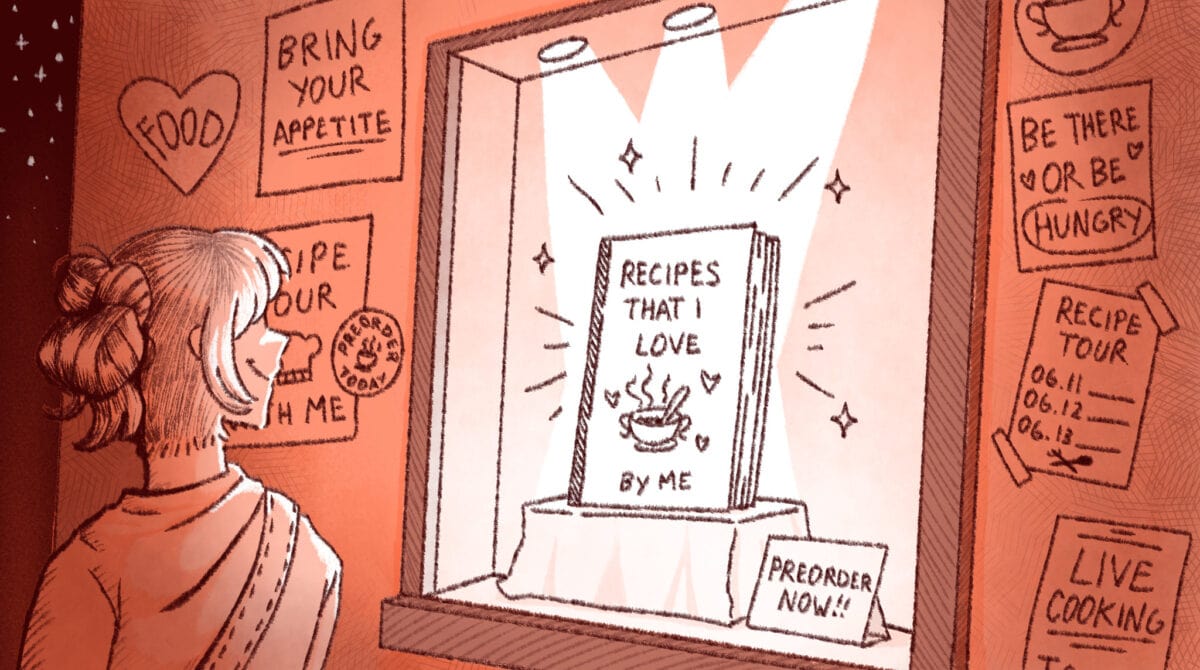
The window between pre-order and pub date is when your audience is most reachable and most excitable. The book is new to them. It isn’t new to you. You’ve been looking at it so long it stopped feeling exciting. But that’s the job: borrow someone else’s excitement if yours has run out.
Give incentives for pre-orders!
Every pre-order counts toward the bestseller lists. Day-of-purchases count, too. So every pre-order you pull forward is a vote that lands before the finish line. That changes the math on what’s worth doing in those weeks.
Dan Pelosi’s second cookbook, Let’s Party, ran a weekly giveaway tied to proof-of-purchase uploads. Each week, a new prize. Each week, something new to talk about that wasn’t just “buy the book” again.
People who had already pre-ordered could find their receipt, upload it, and be in the running to win amazing bundles and packages! He was even able to shift some of the messaging to “Gift a copy!” which doubled the chance to win the giveaway prize. The whole mechanic gave the audience something to participate in, not just receive.
The design question
Something changes when the cookbook cover is out. Your audience can now see what your book looks like: the color palette, the art direction, the aesthetic you spent years building. And then they go to your website, which looks exactly like it did before.
That disconnect is real, but there are ways to close the gap in a way that feels right for you.
Molly Baz’s approach: full immersion. When a new book comes out, everything on her website shifts: fonts, colors, feel. The site becomes the book. That’s a deliberate choice about what era you want to live in.
Caroline Chambers’ approach: continuity. Her books (so far) are sisters – same spirit, same title format, different volume. The website evolves, but doesn’t fully transform. Colors update, photos align, but the structure stays. The new book gets power without making the old one feel irrelevant.
Dan Pelosi’s approach: permanence first. His site is designed to feel like it belongs to no particular moment. The book gets priority treatment, it’s the A1 content, but the site doesn’t reorganize around it. The aesthetic is consistent enough that it works.
None of these is the right answer. The right answer is the one that matches how you want to be known across more than one book.
Engage with your audience, both online and in person
Your tour is going to eight cities, but only a small portion of your audience can attend.
Most authors treat that as a limitation, but we see it as an opportunity. It’s a reason to be surveying your audience constantly, long before the tour is booked, long before the pre-order is live.
Where do they live? What cities keep coming up? What are they asking for?
That data doesn’t just inform your tour routing. It informs your publisher conversations, your bookseller relationships, and every launch decision that follows.
The people who can’t make it to a tour stop still want to feel like something is happening for them. Email them a recap the morning after each stop. Go live on Instagram from the signing line. Bring the conversation into your membership. Ask them for restaurant recommendations in the cities you’re headed to and then actually go. Let the people who aren’t in the room feel the texture of the room anyway.
An audience that feels included in a launch, not just marketed to during one, shows up differently. They tell people. They gift copies. They show up for the next one.
Let it live on
This one’s almost always overlooked. The tour ends. Everyone’s tired. The site still has a pre-order page.
Turn it into a recap. Post the BTS footage. Keep a form asking where people want you to tour next. The web doesn’t have a 24-hour shelf life. A tour recap that lives on your site for the next year is worth more than the Instagram stories that archived three days after you got home.
The moment you can’t get back
You’ve spent two years making something incredible. The window when it’s new to your audience is short.
The website is part of the answer. Not all of it, but most people treat it as one page and an afterthought. Build the whole thing. Start earlier than you think you need to.
The question was never just “how do I sell this?” It’s: “how do I make sure I don’t look back and think I lost that moment?”