


You’ve built an audience. The question is whether you can actually reach them, or whether an algorithm gets to decide that for you every day.
Newsletters outperform social media for monetization, and this holds structurally across creators, regardless of niche or follower count.
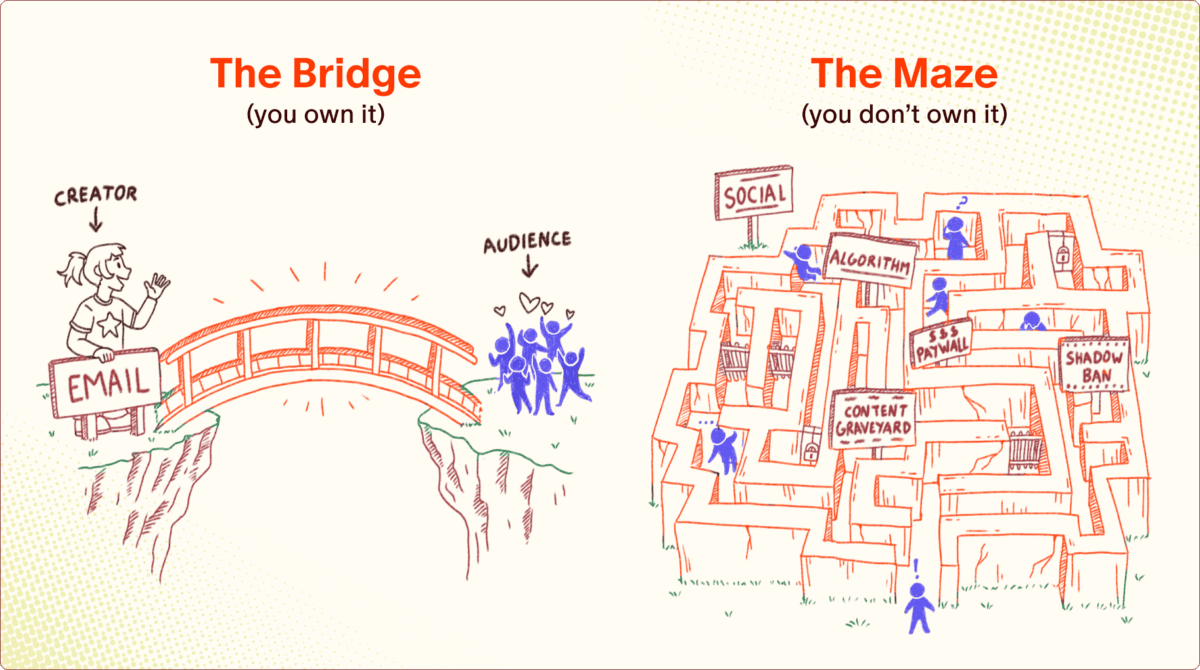
Here’s what that means:
On Instagram, your content runs through algorithms you don’t control, don’t see, and can’t appeal to. The platform decides who sees your work today, and that decision can change tomorrow without a note.
Email runs on a different foundation entirely, one where the difference shows up in the architecture, not on the surface.
Email algorithms respond to the recipient.
Most people think of email deliverability as something platforms do to senders. It isn’t. The spam filter, the inbox priority, all of it is built around the recipient, not the brand.
If someone opens your emails, reads them, and clicks through, they’ll keep landing in the inbox, front and center. If they never engage and don’t remember signing up, the system quietly begins to route the email to spam.
Nobody’s punishing you. The algorithm is just reading the relationship for what it is.
That’s the opposite of Instagram, where reach can drop regardless of how your actual audience feels about you, because the platform is optimizing for its own goals, not yours.
Email compounds the relationship, not the attention.
We’ve watched clients with genuinely massive followings across every channel imaginable: television, brand deals, six-figure audiences on four different platforms. And the pattern holds every time.
The person who follows on TikTok isn’t the same person following on Instagram, who isn’t the same person on the email list. Some overlap. Mostly, they don’t. Each channel you skip isn’t a shortcut. It’s a group of people you never reach at all.
Email is the one channel built for depth instead of volume. And depth is what makes the law of reciprocity work: if what you send is genuinely valuable, the person receiving it starts to feel like they owe you something back.
The mechanism rarely feels transactional in the moment. It feels more like the newsletters your own team forwards to each other, unprompted, because they were worth passing on. That instinct, “I should tell someone about this,” is the whole mechanism.
You can’t manufacture it on a feed, but you can build it, deliberately, in an inbox.
Direct access is the advantage.
Your inbox is the one place your audience shows up because they chose to, not because a feed decided to show them your face today. Someone gave you their email address. They said “yes” to hearing from you specifically.
No platform or algorithm gets to decide whether that message is worth showing. There’s no intermediary between what you wrote and what they read. The relationship is direct: yours to maintain, entirely outside an algorithm’s authority to withhold.
This is also why “I don’t have anything to sell right now, so why would I email?” is the wrong question. Waiting for a launch to show up in someone’s inbox is like only calling a friend when you need something from them.
The ask isn’t the point of the relationship. It’s the eventual byproduct of one that’s been nurtured and maintained. Treat your email list like a pen pal, not a megaphone, and when you do have something to sell, the audience already trusts the voice asking.
Listening is a discipline you build on purpose.
The instinct, when someone tells you what they want, is to build exactly that. Someone says they love chats on a certain app, and the reflex is to go set one up.
But what they actually said was that they like chats. What they like about the format, the immediacy, the intimacy, the sense of being heard in real time, is the real signal. The specific app never mattered.
That’s the gap between listening and reacting. Listening means asking, then sitting with the answer before deciding what to do with it. A plain, specific question (what do you cook most, where do you shop, what’s the one ingredient you’d never skip) tells you more about an audience than any dashboard.
You don’t need a plan for what you’ll do with the answer before you ask it. You just need to actually collect it, on a rhythm, and review it regularly enough that patterns surface. That’s the part most people skip. Usually because the payoff of the information isn’t obvious yet, not because the practice itself takes much effort. Do it anyway. The picture builds itself over time.
Email has a longer memory.
There’s a version of this that shows up personally, too: scrolling old memories and seeing an ad for something you only ever said out loud, once, years earlier, and having that same uncanny “they’re reading our minds” reaction everyone has now.
We understand algorithms today in a way we didn’t a decade ago. Every platform is quietly optimizing for something, and it’s rarely your relationship with your own audience. Email is one of the only channels where the incentive lines up: the platform rewards genuine engagement, not just time-on-site.
That longer shelf life has less to do with flash or single-moment performance. It comes from an incentive structure that never optimizes you out of the relationship it’s supposed to be carrying.
The question worth sitting with:
What percentage of the audience you’ve built could you actually reach tomorrow, if every platform you don’t own disappeared overnight?
For most people, the honest answer is smaller than they’d like, and the gap usually traces back to where the relationship lives, not how strong the audience actually is.
If you’re looking to build an audience on a platform you actually own, let’s connect!