


Most lead magnets disappoint for one simple reason: they were built to capture an email address… not to be valuable.
A lead magnet isn’t just a PDF, checklist, quiz, or five-day email series. It’s a value exchange. A human being is giving you access to their inbox – one of the few digital spaces they still have some control over. In return, they’re hoping you give them something that creates immediate value.
Here’s the framework we use to fix that.
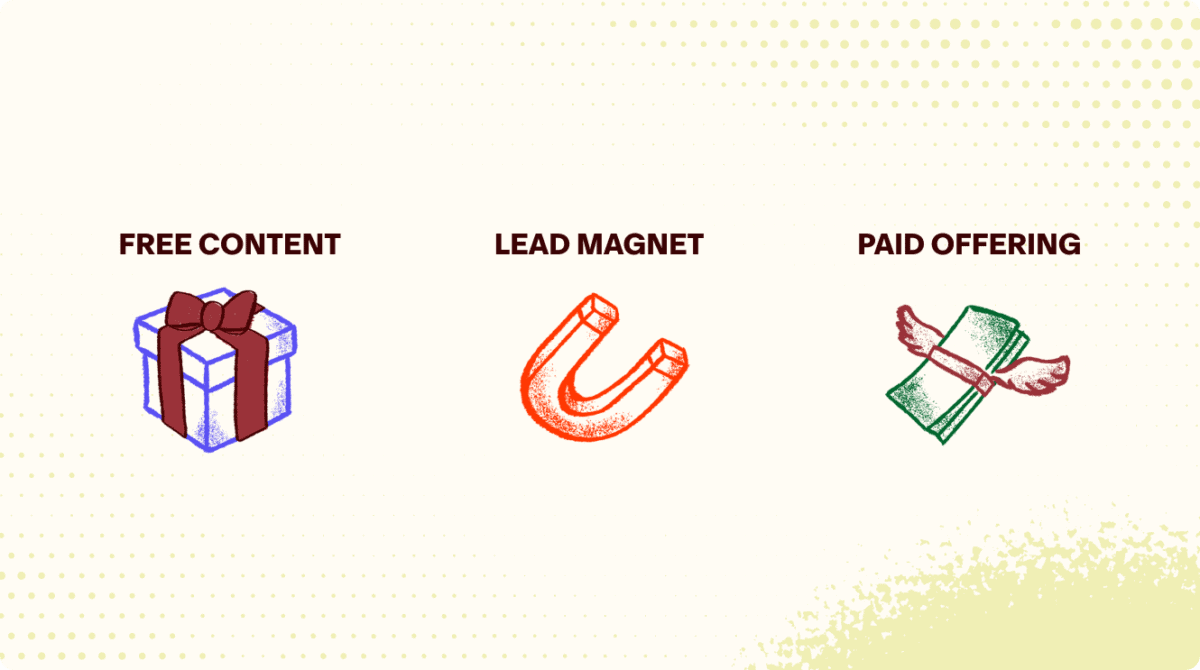
The value framework
We worked with someone recently who had twenty years of experience in their field, a real audience, and a strong following. When we sat down to map their content, we asked a simple question:
What information do you know that other people need?
The answer was massive.
The issue wasn’t a lack of expertise. It was a pricing and packaging problem. They had been giving away some of the most valuable pieces for free, while charging for things that didn’t create enough leverage.
So we built a value ladder around one rule: Match the price to the time it saves.
If it helps people think differently, keep it free.
That includes your perspective, philosophy, principles, and point of view. This is your content. It builds the audience, earns trust, and helps people understand how you see the world.
Give that content away freely. The thinking is what creates demand for bigger, better, more valuable (worth paying for) content.
If it saves someone hours or days, make it your lead magnet.
That might be a checklist, template, worksheet, script, swipe file, calculator, or shortcut they would otherwise have to build themselves.
It’s still free, but it costs an email address.
And this is the key: it has to actually save time.
Not theoretically. Not after they complete twelve steps. Not after they read 18 pages and figure out what to do next.
It should feel useful almost immediately.
If it saves someone weeks or helps them make hundreds of dollars, charge a small amount.
This could be a mini-course, a tactical system, a deeper resource, or a done-for-you asset.
The price doesn’t need to be high. It just needs to create commitment and filter for people who are serious about what you’re offering.
If something saves months or creates thousands in value, charge what it’s worth.
That’s where the full course, membership, coaching program, consulting offer, or strategic engagement belongs.
This is where most people get stuck.
They either give away things that should cost money because they’re afraid to charge, or they hide their thinking behind an email wall where it can’t do its real job.
The thinking should be free.
The shortcuts should cost an email.
The systems should cost money.
The lead magnet sits right in the middle, and that’s why it matters so much.
When someone gives you their email address, they’re making a small bet. They’re betting that what you promised is worth the space in their inbox.
If it is, you’ve moved into a new depth of relationship with the client.
But if the lead magnet disappoints, you haven’t just missed a conversion. You’ve trained that person to ignore you.
So before you build another PDF, checklist, webinar, quiz, or email series, ask one question:
Would someone who downloads this tell a friend it was worth it?
If the answer isn’t an obvious yes, it’s not a lead magnet.
It’s a disappointment with a signup form attached.